
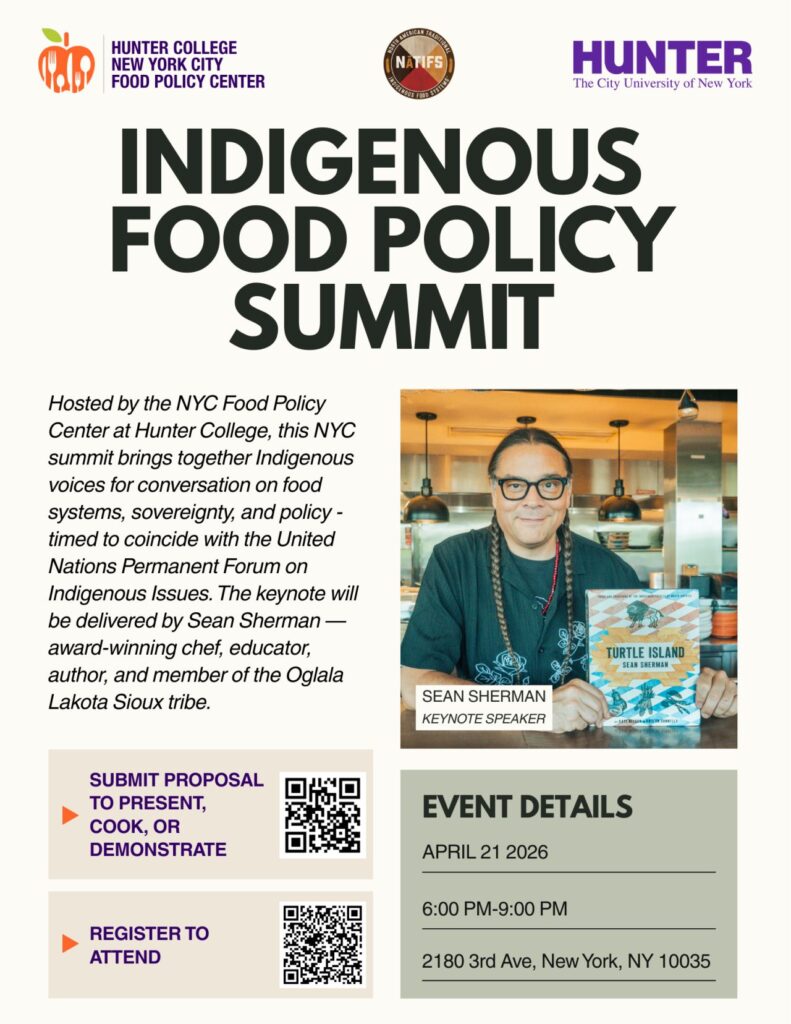
Best4Food participates in the Indigenous Food Policy Summit in New York: a global milestone for food system transformation
Best4Food took part in the Indigenous Food Policy Summit held at Hunter College in New York, a landmark international gathering organized by the New York City Food Policy Center and Hunter College, bringing together Indigenous leaders, researchers, institutions, and practitioners to co-design new models of food governance rooted in justice, biodiversity, and traditional ecological knowledge. The participation of Best4Food and SMILY Academy—in collaboration with G100 Indigenous Communities and Integration—was highlighted as a best practice in advancing the integration of the “Indigenous Factor” into global urban food policies. The initiative was also featured in an international reflection published by Mahabahu, a widely read magazine across more than 50 countries, authored by Claudia Laricchia, Head of International Relations at Best4Food. Read the article here: Indigenous Food Policy Summit: New York set a global precedent – Mahabahu.com
The Summit marked a paradigm shift in global food systems thinking. Opening remarks by Chef Sean Sherman emphasized the urgency of decolonizing food systems and restoring Indigenous food sovereignty through biodiversity, land-based knowledge, and self-determination. A strong institutional example emerged through the leadership of Dr. Mark Chatarpal, whose work at Hunter College demonstrated how food policy can be embedded directly into daily institutional practice, turning universities into living laboratories of social and climate justice.
Best4Food and SMILY Academy contributed by presenting a scalable framework to integrate Indigenous knowledge into urban food governance. The proposal included three core questions—defining the “Indigenous Factor,” understanding its relevance for cities, and identifying concrete implementation pathways—supported by ten operational points aligned with the Sustainable Development Goals. Key elements include knowledge exchange, urban food governance models, food procurement reform, urban food forests, and food justice-based policy design. The contribution of SMILY co-founder Rituraj Phukan, connecting from Assam, further grounded the discussion in living Indigenous systems, highlighting how the Mising communities embody fully functional food sovereignty models based on biodiversity, fermentation practices, and seasonal cycles. A key outcome of the Summit is the shared recognition that scaling does not mean replication, but translation of principles: locality, seasonality, biodiversity, and relational approaches to land as a living system. Indigenous food policies are therefore understood as adaptable infrastructures for cities worldwide. The discussion extended beyond policy into practice, including collaboration with Ribalta Restaurant, where food innovation was explored at the level of the plate. This approach reframes restaurants as cultural and systemic transformation hubs, where sourcing, storytelling, and ecological responsibility converge.
What emerged in New York is a replicable global model of food governance, where Indigenous communities are co-designers of systems, science validates traditional knowledge, and cities operate as regenerative ecosystems. From Milan to Nairobi, Delhi to São Paulo, the framework developed by Best4Food and SMILY Academy is now positioned for adaptation and scaling. The Summit has concluded, but the work of implementation has begun.