
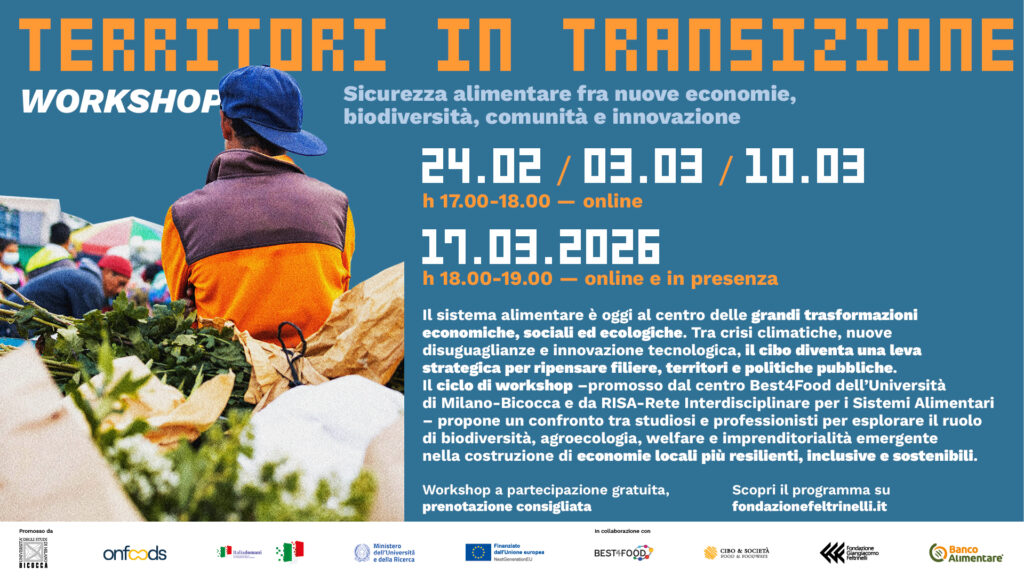
From February 24 to March 17, Best4Food – the Interdepartmental Center for Food Science and Technology at the University of Milano-Bicocca – together with RISA (Interdisciplinary Network on Food Security) and in collaboration with the Giangiacomo Feltrinelli Foundation, promotes the workshop series “Territories in Transition. Food security among new economies, biodiversity, communities and innovation”: three online meetings and a final event also held in person (Viale Pasubio 5, Milan).
We spoke with Laura Prosperi, Director of Best4Food and Professor of Economic History at the Department of Economics, Quantitative Methods and Business Strategies (DEMS) at our university. Interview by Rossella Guido on BNews HERE.
Professor Prosperi, why is talking about “territories in transition” today the key to discussing food security?
The food system can no longer be understood solely in terms of quantities produced or the efficiency of global supply chains. The workshop series we have developed starts precisely from the recognition that the food system now lies at the center of major economic, social, and ecological transformations. Amid the climate crisis, growing inequalities, and technological innovation, food becomes a strategic lever to rethink supply chains, territories, and public policies.
In this context, food security is not only about access to food, but about the capacity of territories to adapt, regenerate, and ensure sustainable production, social equity, and economic stability over time, within a transformative system that also relies on innovation, research, and technology—provided they are guided by clear values and fair, inclusive purposes.
The shift in perspective that this workshop series seeks to bring to public debate and policymaking is precisely this: there are no secure food systems without resilient territories. Speaking about territories in transition means recognizing that food security is built by integrating agriculture, environment, welfare, and local development; that policies cannot be sectoral, but must foster dialogue among urban planning, natural resource management, and employment policies; and that the ecological transition is also a cultural and productive transformation. A territory in transition is capable of responding to climatic, economic, and geopolitical shocks. We are therefore shifting the focus from “how much we produce” to “how we organize our territorial systems to guarantee food, equity, and sustainability in the long term.”
Concretely, where can digitalization, transparency, and short supply chains make a difference, and where do they risk remaining mere slogans?
I believe this remains a key issue, since at no other time in history has the boundary between measurable impact and representation been as blurred as it is today.
Technology can indeed contribute in unprecedented ways to transparency standards, but it also fuels the illusion that the obstacles are merely technical. Obviously, this is not the case: food remains the most universal business human societies are capable of, the only incompressible one, generating enormous profits. Silencing certain segments of the supply chain—for instance regarding profit distribution—has little to do with technical limitations and responds instead to vested interests. Transparency within a supply chain stems from more balanced power relations among its actors: without changes in socio-economic structures, digital tools produce only dissonance and reinforce the illusion of greater transparency.
As for supply chain length, I represent a particularly critical perspective: counterintuitively, even a shorter supply chain can result from imbalances—territorial, for example—that are far from desirable. The call for short supply chains is too often used as a slogan and a cure-all, whereas distance is only one of many variables to consider.
The program frequently refers to biodiversity, communities, and new economies. What does it mean to bring them together within a single agenda?
It means recognizing that these are not separate themes, but interdependent dimensions of the same transformation. In other words, biodiversity is not only an environmental issue: it is the foundation of food security, territorial health, and the resilience of production systems. Without biodiversity, there is no sustainable agriculture and no future for food. Today, according to FAO data, more than 30,000 edible plant species are available worldwide. Of these, around 6,000 have historically been cultivated for food, yet fewer than 200 contribute significantly to global food production. Even more striking, nine crops—including rice, wheat, and maize—account for about 66% of total global agricultural production. This data alone illustrates the connection between biodiversity, the communities that thrive around those crops, and the new economies that should connect and enhance them.
Knowledge, agricultural practices, food cultures, and social relationships are key ingredients of the social dimension of biodiversity. Placing them at the center means overcoming an extractive approach and building supply chains that are more equitable, inclusive, and responsive to the needs of their territories.
Finally, new economies are the tools to make this vision concrete and scalable, through regenerative economic models that measure impact beyond profit and innovate without destroying natural resources.
The systemic vision required to approach agri-food systems enables us to analyze the connections between biodiversity, communities, and new economies, addressing the three dimensions of sustainability they represent: environmental, social, and economic. The Best4Food Research Center at Milano-Bicocca embodies this vision and projects it into reality at local, national, and international levels.
Three online dates and a final in-person event: with this hybrid format, what kind of audience do you expect, and what outcome would you like to achieve at the end of the series?
The online format allows us to broaden participation, engaging a national and international audience: researchers, students, policymakers, innovative businesses, third-sector organizations, and local administrators. We aim to create an interdisciplinary space for dialogue, because the transition of food systems does not concern a single sector but requires the exchange of multiple perspectives.
The in-person event has a different value: building relationships, generating alliances, and fostering concrete projects. Transition does not happen through ideas alone, but through operational networks. We therefore expect a mixed audience: the research community, contributing evidence and data; companies and startups interested in innovative and sustainable business models; third-sector organizations and local communities, often the first laboratories of territorial experimentation; active citizens and young professionals who see food as a lever for change.