Food Policies Beyond Food: Towards a New Generation of Food Policies for the Cities of the Future
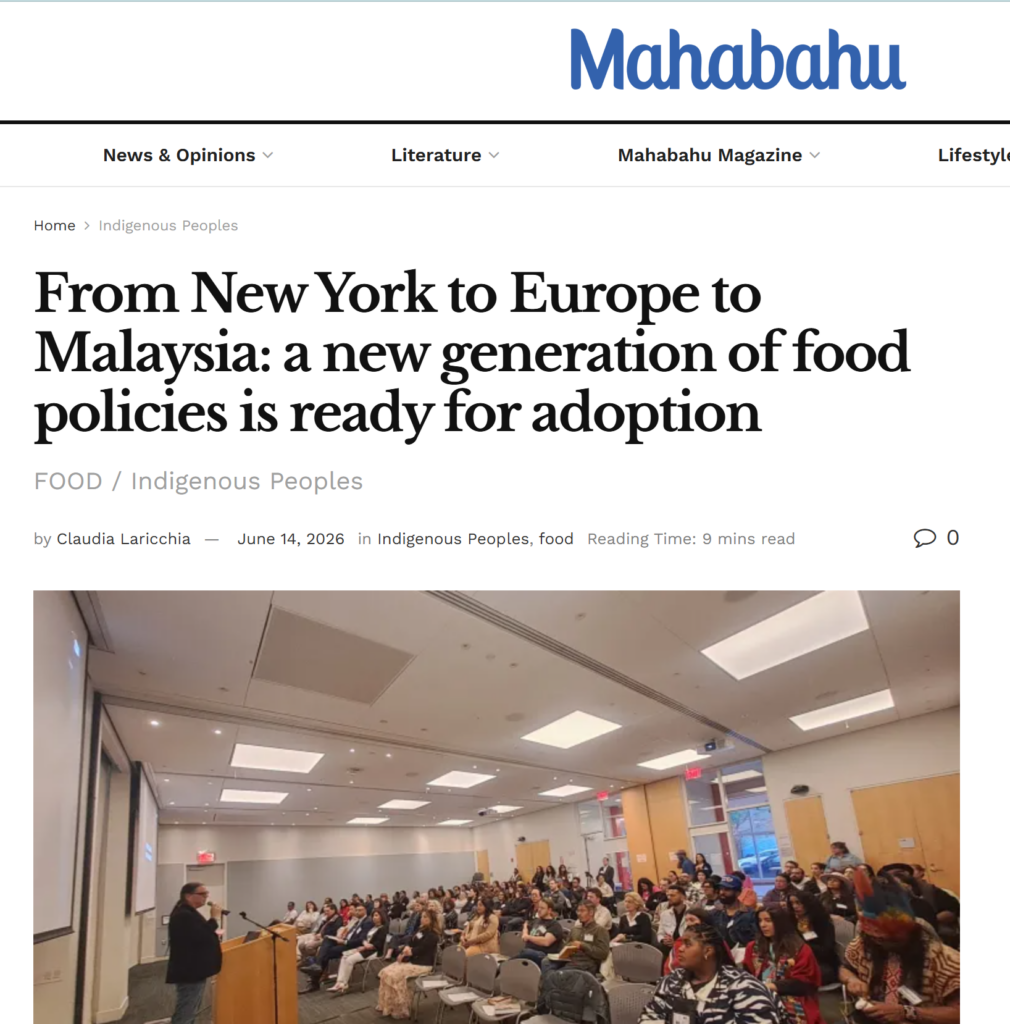
Food policies are no longer only about food. They are increasingly about climate action, public health, social justice, economic development, and the ability of territories to build resilience. This is the vision at the heart of Food Policies Beyond Food, a white paper developed by SMILY Academy in collaboration with ConfBenefit AISBL, the Indigenous Peoples’ Climate Justice Forum, G100 Indigenous Communities and Integration, and Best4Food – Food Science and Technologies Center at the University of Milano-Bicocca. This is the core of Claudia Laricchia’s article on Mahabahu Magazin, read in over 50 countries. Article: From New York to Europe to Malaysia: a new generation of food policies is ready for adoption – Mahabahu.com The journey leading to the publication of the paper began in April 2026 in New York City, where SMILY Academy was selected by the New York City Food Policy Center and Hunter College to present an innovative framework for urban food policies based on the integration of the so-called Indigenous Factor. The framework was introduced during the Indigenous Peoples’ Food Policy Summit, bringing together Indigenous communities, universities, social innovators, policymakers, and researchers. The paper starts from a simple yet profound observation: food has become one of the key intersections of some of the most pressing challenges of our time. Climate change, public health inequalities, biodiversity loss, food supply chain vulnerabilities, and social fragmentation are deeply interconnected issues that require systemic approaches and new governance models. The framework identifies three key ingredients for the future of food policy. The first is the recognition that food policy can no longer be treated as a standalone sector. Decisions related to food systems have direct implications for human health, climate resilience, local economic development, and community well-being. Food policies therefore represent a strategic entry point for addressing broader societal challenges through integrated and cross-sectoral approaches. The second ingredient is the Indigenous Factor, which refers to the integration of principles and practices derived from Indigenous food systems, including ecological intelligence, biodiversity stewardship, food sovereignty, regenerative practices, community governance, and relational thinking. From this perspective, resilience is not generated solely through technological innovation and efficiency, but also through the quality of relationships between people, ecosystems, territories, and communities. The third ingredient concerns governance. The white paper proposes the creation of Territorial Impact Ecosystems, collaborative platforms in which municipalities, universities, mission-driven businesses, food producers, hospitality operators, investors, foundations, civil society organizations, youth networks, and Indigenous communities work together as co-designers of local resilience strategies. Within this model, food becomes a living infrastructure. Schools and hospitals can leverage public procurement to support healthy and local food systems; educational institutions can become centers for food literacy and climate awareness; restaurants can promote regenerative sourcing and cultural heritage; and universities can translate research into practical solutions that benefit communities and territories. For Best4Food and the University of Milano-Bicocca, participation in this initiative represents an opportunity to strengthen the connection between scientific research, social innovation, and food system transformation. The framework provides a practical platform for bringing together academia, public institutions, businesses, and citizens to co-create more sustainable, inclusive, and regenerative food systems. The journey that began in New York will continue in the coming months at the Women Economic Forum 2026 in Kuala Lumpur and the Women Economic Forum in Turin, where the framework will be further discussed, tested, and refined with policymakers, researchers, entrepreneurs, and international organizations. The challenge is ambitious but necessary: to use food policies as a catalyst for regenerating territories, strengthening communities, and accelerating the transition toward more sustainable development models. Because the future of food is increasingly intertwined with the future of our cities.